My Vehicle
Cart
12 Volt Direct 12 November 2026
Starlink unveiled the Starlink Mini 2 on 10 November 2026. Its headline feature is a removable battery, so the dish can run for a few hours with no power lead at all. It also switches to USB-C power and gets Wi-Fi 6.
Naturally, plenty of Australian 4WD, caravan and camping customers are asking whether they should wait for it. In this guide we cover what's confirmed, what's still unknown, and how it stacks up against the original Starlink Mini, which is available in Australia now for around $299 on promotion and is supported by our full Starlink Mini accessories range.
We've labelled what's officially confirmed, what comes from unofficial firmware research, and what's our own expectation as a 12V and touring specialist.
71 Wh
Removable Battery
4.5 h
Quoted Battery Life
60 W
USB-C Power Input
1.6 kg
Weight With Battery
Specifications from Starlink's Starlink Mini 2 page and launch reporting (ISPreview). Australian specs and kit contents may differ.
| Specification | Original Starlink Mini | Starlink Mini 2 |
|---|---|---|
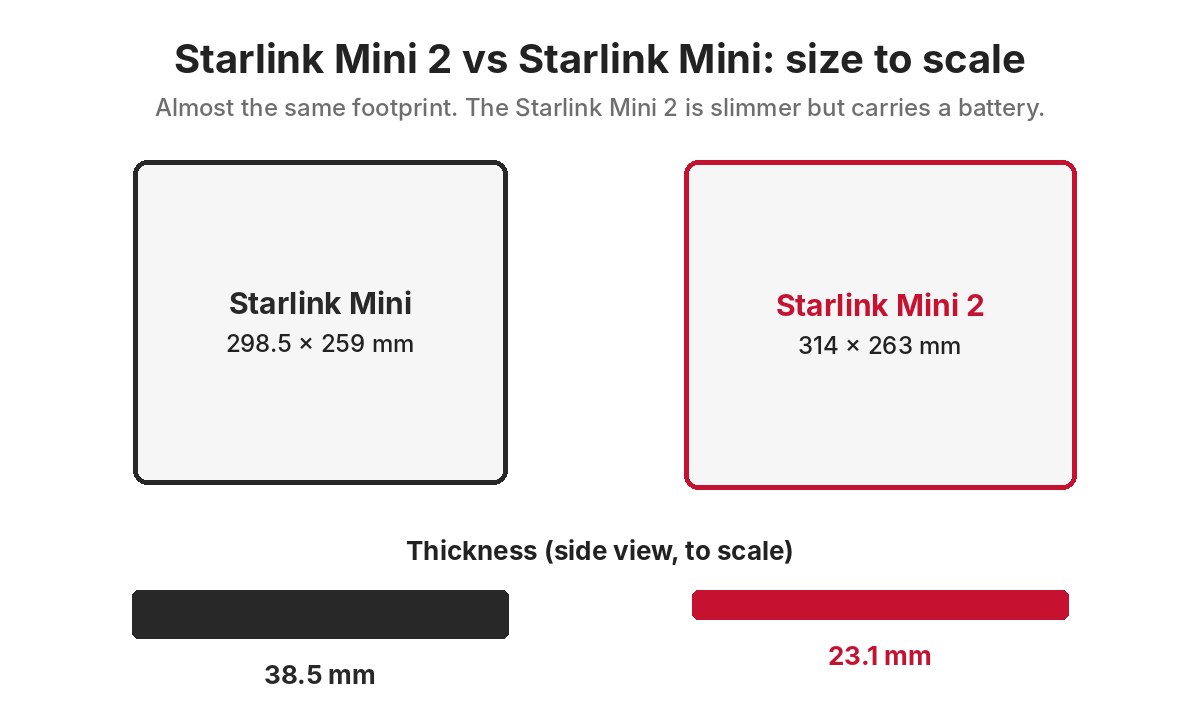
| Dimensions | 298.5 x 259 x 38.5 mm | 314 x 263 x 23.1 mm |
| Weight | 1.16 kg with kickstand | Approx. 1.6 kg with battery and kickstand |
| Battery | None | Removable 71 Wh |
| Battery life | Depends on your external power supply | Up to 4.5 hours (quoted) |
| Power input | 12 to 48 V DC barrel connector | USB-C, 60 W Power Delivery |
| Average power use | 25 to 40 W (official) | Not published |
| Wi-Fi | Wi-Fi 5 | Wi-Fi 6 |
| Weather rating | IP67 (under specified conditions) | IP67 (under specified conditions) |
| Mounting | Starlink Mini-specific fittings | Different mounting system, standard 1/4-20 camera thread |
| Australian availability | Available now | Not announced |
| Australian price | Approx. $299 on promotion | Not confirmed |
Original Starlink Mini figures from Starlink's Starlink Mini specification sheet. Promotional pricing changes, so check current offers.
The Starlink Mini 2 isn't dramatically smaller. It's about 15 mm thinner, but slightly larger across its face, and around half a kilo heavier with the battery fitted.
For most Australian 4WD and caravan owners, we don't think waiting makes sense. Here's why.
It isn't expected to be cheaper
The original Starlink Mini is around $299 on promotion. Australian Starlink Mini 2 pricing hasn't been announced, but we expect the new hardware to carry a premium over that, at least at first. If you're waiting because you expect the Starlink Mini 2 to be cheaper, we think that's highly unlikely.
Don't count on it for Christmas 2026
There's no Australian release date, and first US deliveries are reportedly not due until mid-December. Planning a Christmas camping trip or summer holiday? Don't count on the Starlink Mini 2 arriving in time. The original Starlink Mini is available now.
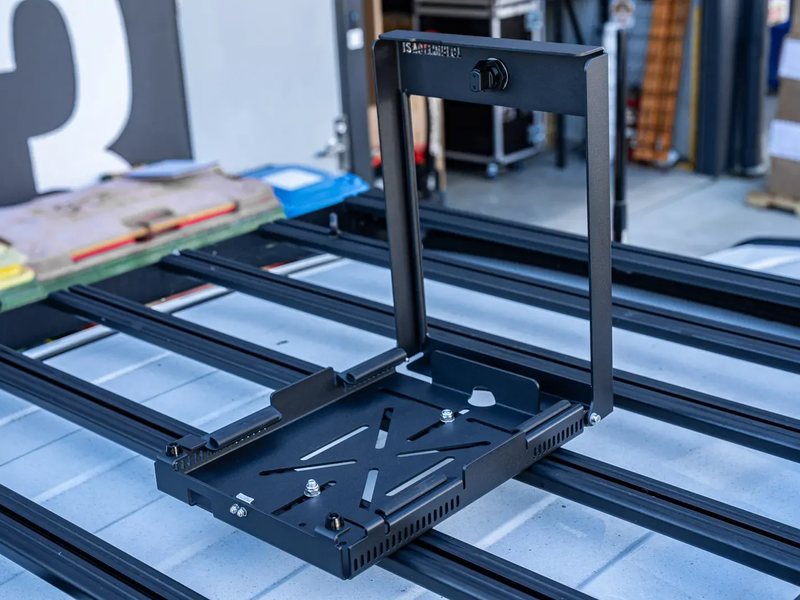
Your Starlink Mini mounts won't fit
The Starlink Mini 2 has a different shape, size, battery attachment and power connection. If you switch, budget for new mounting hardware, power leads and probably a new case.
The original Starlink Mini is proven
It's one of the most popular satellite internet products with Australian travellers, with an established track record and a large range of compatible accessories.
Newer isn't automatically better
The removable battery and Wi-Fi 6 will suit some people, but if your Starlink Mini runs from a vehicle or caravan 12V system, you may see little benefit. Upload performance and battery behaviour in high heat still need real-world testing.
Before launch, Starlink researcher Oleg Kutkov analysed firmware for the Starlink Mini 2 and shared his findings publicly. He reported that the dish's transmit duty cycle drops from about 75% on the original Starlink Mini to about 11% on the Starlink Mini 2 (reported by Notebookcheck).
The transmit duty cycle is the share of time the terminal is permitted to transmit, which is how your data gets up to the satellite. Transmitting less can cut power use, which would make sense for a dish designed to run from a small removable battery. Kutkov said the limit is most likely driven by the terminal's power budget, though Starlink hasn't confirmed this.
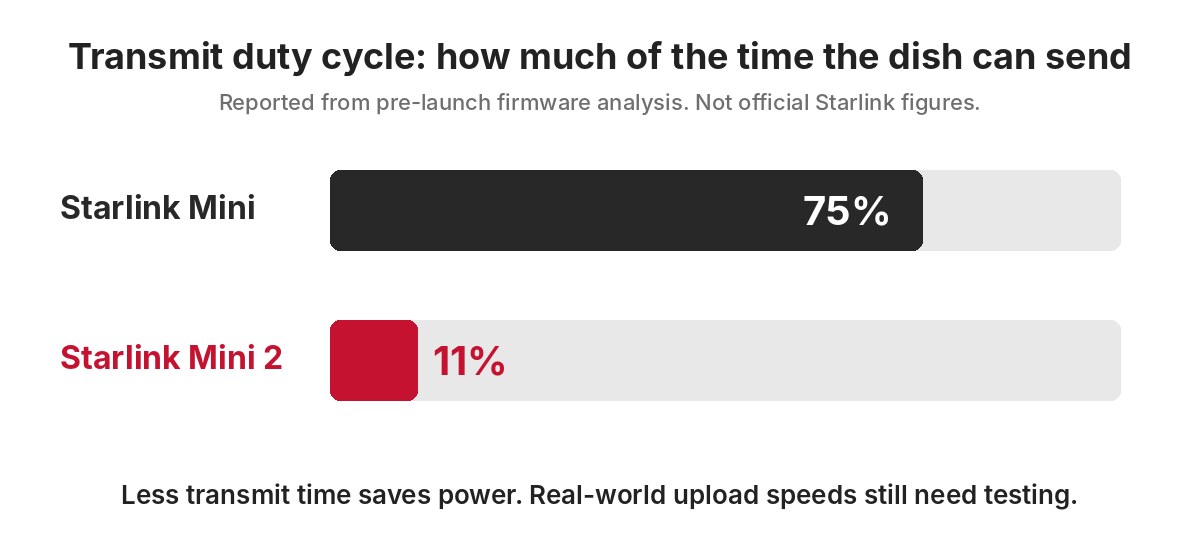
What this doesn't tell us is the actual upload speed. Duty cycle doesn't convert directly into throughput, and some analysis has estimated uploads around 10 Mbps, but that's an estimate, not a confirmed figure. Download performance also needs to be tested before anyone can say it matches the original Starlink Mini.
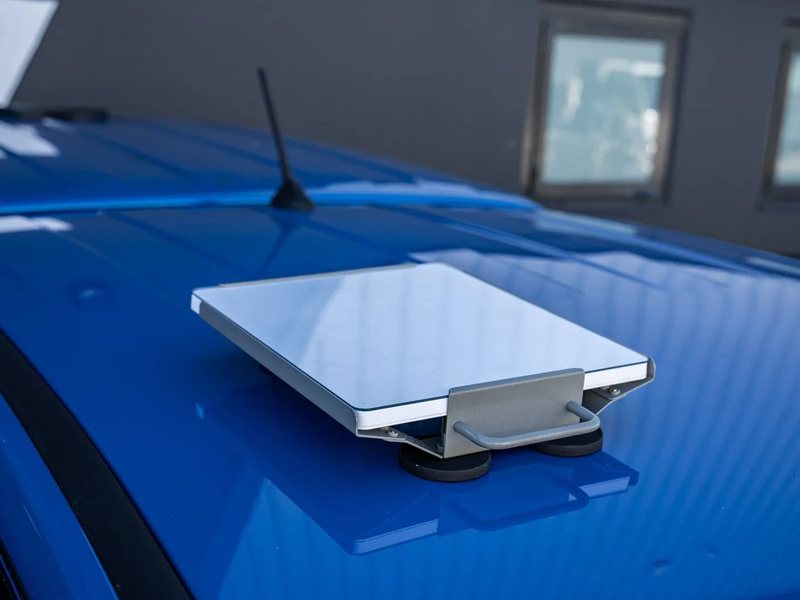
Many Australian travellers mount their Starlink Mini on a 4WD roof, roof rack, caravan or camper trailer roof, canopy or magnetic vehicle mount, often for days at a time. Summer air temperatures can top 40 °C in outback regions, and a roof sitting in direct sun gets much hotter than the air around it.
Like all lithium batteries, the Starlink Mini 2's battery will have its own limits for charging, discharging and storage temperatures, and those are separate from the outside air temperature. Starlink hasn't published an operating temperature range for the Starlink Mini 2 yet (the original Starlink Mini is rated from -30 °C to 50 °C). Pre-launch firmware research also reported a battery thermal shutdown threshold of 80 °C. That's a protection cut-off, not the temperature the battery is designed to charge at.
We're not suggesting there's anything wrong with it. Like any lithium battery product, it will be managed by a battery management system. But these are the practical questions we want answered once we can test one in Australian conditions:
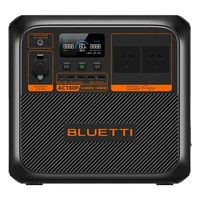
The original Starlink Mini has no onboard battery. It runs from an auxiliary lithium battery, the vehicle's electrical system or a portable power station. That means your battery can live somewhere protected, such as the canopy, cabin or caravan battery box, while the dish sits outside on the roof.
It also means much more runtime. A typical 100 Ah 12V lithium auxiliary battery stores about 1,280 Wh, around 18 times the Starlink Mini 2's 71 Wh. With an average draw of 25 to 40 W, the original Starlink Mini can run for a long time from a setup most tourers already have. Our plug and play portable lithium battery guide shows one simple way to set that up. A built-in battery matters a lot if you're carrying the dish on a hike, but much less in a 4WD or caravan with an established 12V system.
Here's the timeline so far:
Given that timeline, widespread availability through Australian retailers before Christmas 2026 looks unlikely. We wouldn't plan a summer trip around it. We'll update this article as soon as Starlink confirms Australian details.
Starlink hasn't announced an Australian retail price. In the US, the introductory pre-order offer is US$999, which includes the Starlink Mini 2 hardware, one removable battery and 12 months of Roam Unlimited service (Notebookcheck). That's a hardware and service bundle, not the price of the dish on its own, so it can't simply be converted into an Australian hardware price. There have also been reports of a lower US hardware-only figure found in Starlink's website code, which Starlink hasn't confirmed.
Our expectation, not an official price: the Starlink Mini 2 will carry a premium over the original Starlink Mini's current promotional price of around $299, at least at launch. If you're holding off because you expect the new model to be cheaper, we think that's highly unlikely.
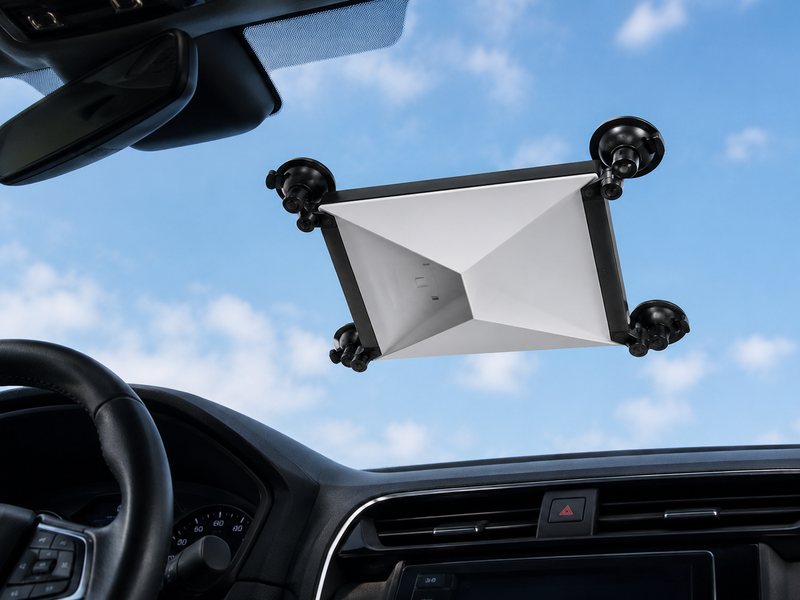
No. Model-specific Starlink Mini mounts are designed around the original dish's shape, size and fittings. The Starlink Mini 2 has different dimensions, a different mounting arrangement and a battery on the back, so those mounts won't fit. The same goes for cases shaped for the original dish, and barrel-connector power leads won't plug into the Starlink Mini 2's USB-C input.
Some universal mounting gear may be adaptable, because the Starlink Mini 2 has a standard 1/4-20 camera thread, but check each product individually. If you're thinking about switching, budget for new mounting hardware, power connections and possibly a new case.
We're already researching and developing Starlink Mini 2 accessories, including USB-C power supplies and cables, mounting brackets and cases. We'll only list them as compatible once we've tested them on the real dish.
Meanwhile, here's how our customers run the original Starlink Mini today:
The original Starlink Mini accepts 12 to 48 V DC, but it doesn't like low voltage. As a 12V battery drops under load, or voltage is lost along a long or thin cable, the dish can drop out or reboot. A regulated 12V to 30V booster gives it a steady supply in compatible installations. That's why we make the 12V to 30V booster with Anderson plug and the 12V to 30V booster with cigarette plug, plus DC power cables and Anderson style power leads.
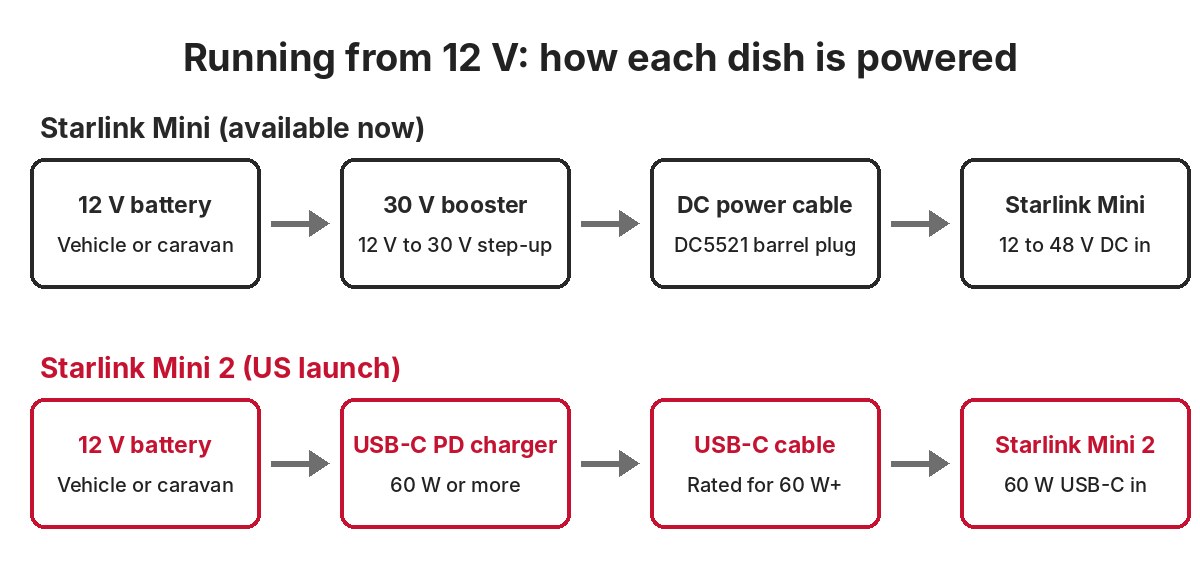
The Starlink Mini 2 changes to USB-C Power Delivery, so it needs a different solution: a USB-C PD power supply and cable rated for at least 60 W. Don't assume existing Starlink Mini power accessories will work. We're testing USB-C power cables and converters for the Starlink Mini 2 now and will publish compatibility once confirmed.
If you specifically need a completely self-contained portable setup, for example for hiking or quick stops away from the vehicle, the Starlink Mini 2 may be worth waiting for once Australian details and real-world testing are in.
If you need internet for a 4WD, caravan, camper trailer, remote work setup or a trip this summer, there are very good reasons to choose the original Starlink Mini now.
Starlink hasn't announced an Australian release date. Pre-orders opened by invitation in the United States on 10 November 2026, with first US shipments reported for mid-December. We don't expect it to be widely available through Australian retailers before Christmas 2026.
There's no Australian price yet. In the US it launched as a US$999 pre-order bundle that includes the dish, one battery and 12 months of Roam Unlimited service, so that figure isn't the hardware price on its own. Our expectation is that the new hardware will cost more than the original Starlink Mini, which is currently around $299 on promotion.
Starlink quotes up to 4.5 hours from the removable 71 Wh battery. Real-world runtime will depend on conditions and use, and the dish can also run from USB-C power.
It hasn't been tested independently yet. Pre-launch firmware research reported the transmit duty cycle dropping from about 75% to about 11%, which suggests lower upload capacity, but duty cycle doesn't convert directly into a speed figure. Independent testing is needed.
Model-specific Starlink Mini mounts and cases won't fit, because the Starlink Mini 2 has a different size, a battery on the back and a different mounting arrangement. Barrel-plug power leads won't plug into its USB-C input either. Some universal mounts may be adaptable using its standard 1/4-20 camera thread, but check each one.
It's designed to take USB-C Power Delivery at 60 W, so a quality 12V USB-C PD supply rated for at least 60 W is the likely approach. We're testing suitable cables and power supplies now and won't list anything as compatible until it's been tested.
Questions about powering or mounting your Starlink Mini? Contact our team.
Last updated 12 November 2026. Starlink Mini 2 details come from Starlink's announcement and published reporting, and may change before an Australian release. Firmware findings are unofficial. Prices and availability are current at the time of writing.