My Vehicle
Cart
12 Volt Direct 6 November 2026
Good coffee is one of the first things people miss when they head bush. You can get a proper espresso-style coffee at camp without gas, a kettle or a generator, but there are a few ways to do it and they suit different setups. This guide explains your options, how much battery each one uses and how to wire a 12V machine safely.
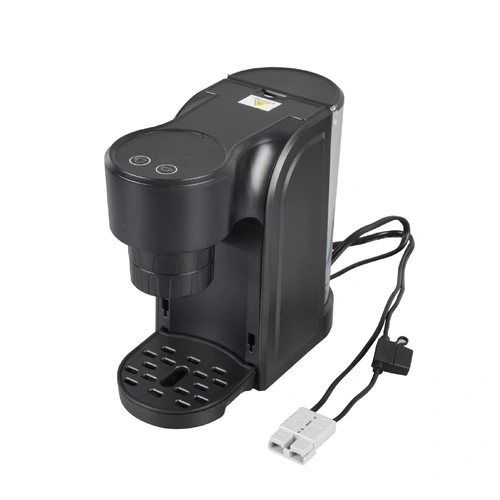
The short answer: if you have a lithium or AGM battery with an Anderson-style socket, a true 12V coffee machine is the simplest option. Ours heats cold water itself in about 2 minutes and uses about 0.8Ah per large coffee, so a 100Ah battery makes more than 100 coffees per charge. No inverter, gas or kettle needed.
| Option | What you need | Time to a coffee | Battery or fuel use | Best for |
|---|---|---|---|---|
| True 12V pod machine | 12V battery, 50A Anderson-style socket | About 2 minutes | About 0.8Ah per large cup | Caravans, canopies, campers and utes with a battery system |
| 240V machine on an inverter | Pure sine inverter (usually 1500W or more), heavy cabling, large battery | 1 to 3 minutes once warm | Heats at over 1000W, roughly 100A or more from a 12V battery while heating | Big rigs that already run a large inverter |
| Stovetop or percolator | Gas stove and gas bottle | 5 to 10 minutes | Gas | Tent camping with no battery system |
| Hand-press espresso maker | Hot water from a kettle or stove | 5 minutes or more | Gas or power to boil the water | Hiking and very light setups |
Inverter figures are typical for household machines and vary by model. Check the wattage on your own machine.
Most of the energy goes into heating the water. Our 12V coffee pod machine heats at around 27A for about two minutes, then the draw stops. That works out to:
| Coffees | Battery used (approx.) | Share of a 100Ah battery |
|---|---|---|
| 1 large coffee | 0.8Ah | Under 1% |
| 2 coffees a day for a week | 11Ah | About 11% |
| 4 coffees a day for a week | 22Ah | About 22% |
Add a milk frother and allow about 1Ah more per drink (180W for around 4 minutes). Solar or a DC-DC charger will easily put that back during the day.
A 12V coffee machine draws more current than a cigarette socket can safely carry. Before you buy, check your setup has:
Running two appliances? An Anderson Y splitter lets the coffee machine and frother share one socket. If you are not sure your system can run it, ask our team and we will check it with you.
Our machine comes with two adapters, so you can choose each morning:
The 550ml water tank makes small (40-60ml) or large (90-110ml) cups. A mounting bracket is included for canopies, caravans and utes.
*Nespresso is a registered trademark of Société des Produits Nestlé S.A. This product is not associated with or endorsed by Nespresso.
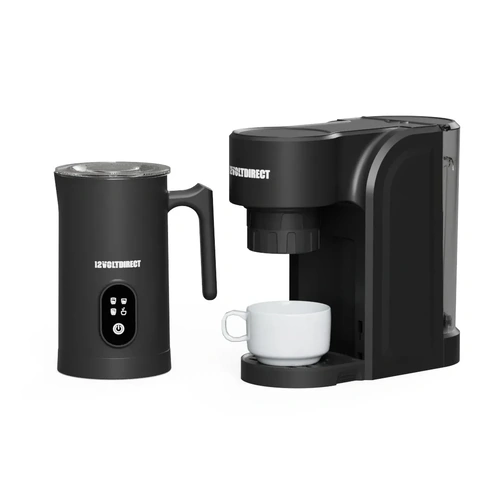
For milk coffees, our 12V milk frother heats and froths up to 130ml of milk in about 4 minutes, or heats up to 430ml for hot chocolate. It runs at 180W from the same Anderson-style socket and switches itself off when done.
Not ours. It draws around 27A while heating (up to 34A at peak), and cigarette and Merit sockets are usually wired for about 10A. Plug it into a 50A Anderson-style socket wired with 12AWG (4mm²) cable and a 40A fuse.
A large coffee uses about 0.8Ah, so a 100Ah battery can make more than 100 coffees per charge. Most people use a small fraction of their battery each morning.
No. A true 12V machine runs straight from the battery. A household 240V machine does need an inverter, and a big one, because it heats at over 1000W.
Nespresso-compatible pods and capsules. A second adapter in the box lets you use your own ground coffee instead.
About 2 minutes from cold water. It heats the water itself, up to 95°C, so there is no kettle or stove involved.
Yes, with our 12V milk frother. It heats and froths milk in about 4 minutes and runs from the same Anderson-style socket. The Barista Bundle has both.
Mount it securely with the bracket supplied, but make your coffee with the vehicle parked. Hot water and a moving vehicle do not mix.